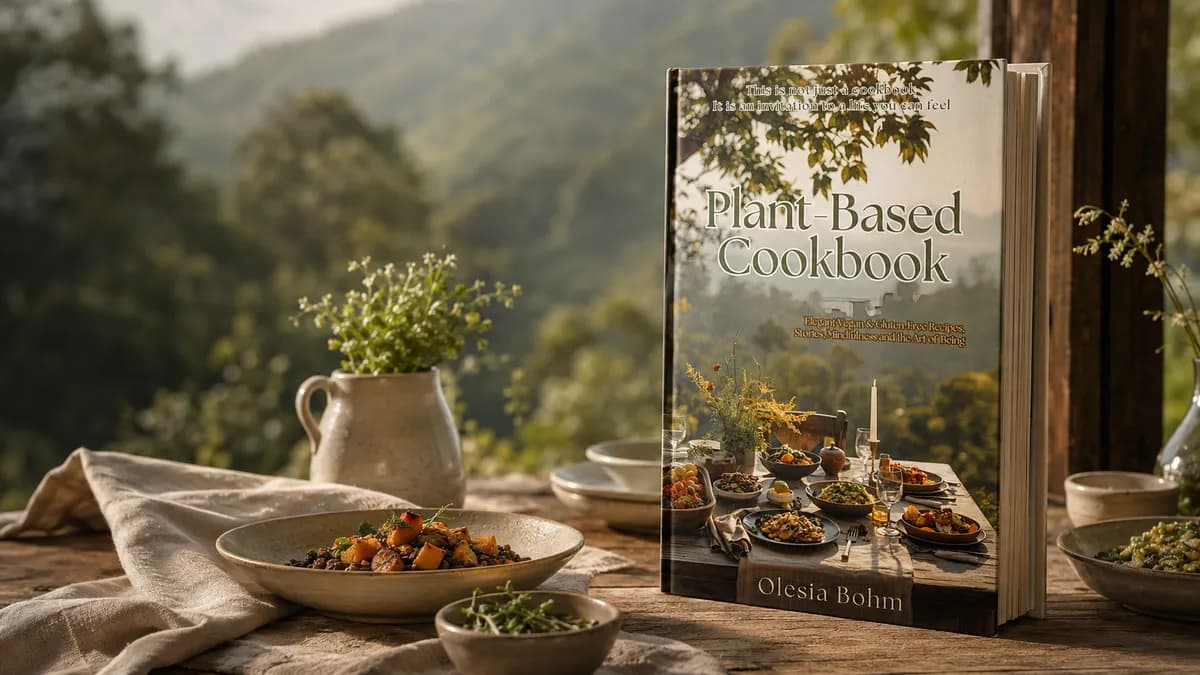
Some cookbooks begin with equipment lists and pantry checklists. Plant-Based Cookbook: Elegant Vegan & Gluten-Free Recipes begins by asking the reader to pause.
That difference tells us almost everything about Olesia Bohm's book. It is a collection of recipes, but also an argument for paying attention: to ingredients, to our hands, to the people we feed, and to the state in which we enter the kitchen. Reading its 170 pages feels less like consulting a manual and more like entering a home where the pace has deliberately slowed.
We should be transparent about our perspective. This book comes from close to the EVE family: Olesia is the wife of our teammate Richard Bohm. We know something of the care behind it. That connection makes this review personal, but it also makes honesty important. The book deserves to be considered for what is actually on its pages - its unusual strengths, its practical value, and the places where readers should exercise care.
More than a sequence of recipes
Olesia is both a vegan chef and a psychologist, and the book becomes most distinctive where those two ways of seeing meet. Each dish is introduced not only by its ingredients but by an emotional intention: softness, grounding, confidence, patience, playfulness. Stories and sensory cues accompany the methods. Journal prompts ask what a dish awakened in the cook or what feeling they want to carry forward.
In less thoughtful hands, this could become decorative wellness language pasted onto recipes. Here, it has a purpose. Olesia is interested in the influence of our inner state on ordinary actions. Chopping, stirring, tasting, and waiting become ways to notice whether we are hurried or present.
Warm cream pages, earthy typography, spacious layouts, photography, and playful illustrations give the recipes room to breathe. The visual rhythm alternates between practical instruction and reflection. Even the personal culinary journal pages turn a finished book into an unfinished conversation with its reader.
This is also where some readers will immediately fall in love with the book and others may not. Someone wanting a compact database of recipes, nutritional tables, or a rigid weekly meal plan may find its reflective pacing leisurely. Olesia has written a companion rather than an efficiency tool. The stories are part of the meal.
The technique beneath the tenderness
The gentle voice should not obscure the cookbook's practical intelligence. Olesia pays close attention to texture, temperature, acidity, and timing. A five-minute Warm Banana & Cinnamon Cream explains how lemon balances caramelised fruit. Homemade granola comes with advice on clusters, post-bake additions, salt, and storage. A windowsill basil guide extends the pantry beyond the jar and back toward the living plant.
The artisan pantry is one of the book's strongest ideas. Vegan mayonnaise, cashew sauce, sugar-free tomato ketchup, mustard, tahini, almond yoghurt, and living apple cider vinegar provide building blocks rather than isolated showpieces. Once these foundations are in the refrigerator, plant-based cooking becomes easier to improvise. The vinegar recipe even turns apple cores and skins into a useful ferment - a small but concrete expression of a lower-waste kitchen.
The main dishes move between simplicity and ambition. Crispy rice cakes with avocado cream are presented as an "anchor point": crisp structure below, softness above, fresh herbs bringing brightness. Carrot lox with cashew cream reimagines a familiar brunch language without fish. A cauliflower steak with herb sauce and citrus oil offers a bistro-style challenge.
The Crispiest Deruny with Carrot & Herbs may be the clearest example of Olesia's method. The emotional subject is home and safety, but the culinary guidance is exact. Half the potato is grated finely and half coarsely; liquid is squeezed out; the settled starch is returned to the mixture; the pan must stay hot and uncrowded. Memory and technique do not compete. One gives the dish meaning, while the other gives it crunch.
Later, slow-stewed lentils, roasted sweet potato with tahini, pumpkin soup, mushroom cream, and a white bean and tomato stew bring the book inward again. Desserts such as baked apples, warm chocolate pudding, vegan tiramisu, and Snickers-, Raffaello-, and Twix-inspired bites make another important point: plant-based food does not have to advertise virtue through deprivation. Pleasure belongs here.
There is one significant editorial issue to flag. The book presents itself as gluten-free, yet it includes a Pearl Barley Orzotto. Barley naturally contains gluten, as the US National Institute of Diabetes and Digestive and Kidney Diseases explains. Anyone with coeliac disease or a medical need to avoid gluten should not prepare that recipe as written; a genuinely gluten-free grain would be required. This should be corrected clearly in a future edition. More broadly, readers managing allergies or clinical dietary restrictions should verify every ingredient and seek qualified nutritional guidance where needed.
From Asturias to EVE
Asturias is not simply a backdrop in this book. Its mountains, rain, Atlantic air, forests, animals, and slower rhythms shape Olesia's language. She describes plant-based cooking there not as a fashionable identity but as a way of participating in a landscape with less disturbance. Whether or not every reader shares that exact philosophy, the sense of place gives the book a center of gravity.
This is where the connection with EVE feels natural. EVE exists to help people form and sustain resilient, human-scale communities rooted in nature and strengthened by appropriate technology. Much of that work involves coordination: matching people by values, sharing responsibility, governing together, stewarding resources, and keeping local systems dependable.
But resilient community life is not built through software alone. People grow herbs, preserve food, prepare meals, reduce waste, pass on skills, and gather around a table. A shared kitchen can be infrastructure, classroom, meeting place, and source of belonging at once.
Olesia's cookbook operates at this intimate scale. It asks what our larger ideals look like on an ordinary morning. Can care for the Earth become a seasonal ingredient? Can resilience become a well-stocked artisan pantry? Can community become a warm bowl carried to someone who needs it? Can attention itself become a form of stewardship?
EVE's philosophy is that technology should support autonomy and human connection rather than replace them. This book offers a culinary counterpart: technique supports presence; it does not replace it. Both imagine a living system in which small actions gain meaning through their relationships with the whole.
Why a plant-rich table matters
Veganism is often discussed as a personal ethical choice, but dietary change also has a collective environmental dimension. The Intergovernmental Panel on Climate Change identifies balanced diets featuring plant-based foods - including grains, legumes, fruits, vegetables, nuts, and seeds - as an important opportunity for climate mitigation and adaptation, with potential benefits for health. Its wider assessment also links plant-rich dietary shifts, especially in places with high consumption of animal products, to reduced pressure on land and ecosystems.
The principle is straightforward. Producing food through animals often requires additional land and crops for feed, while ruminant livestock also produces substantial greenhouse-gas emissions. When many people replace some animal-derived foods with varied plant proteins and minimally processed plant foods, the combined effect can reduce emissions and pressure on forests, water, and biodiversity.
That does not mean every vegan product is automatically sustainable, or that individual consumers can repair the food system alone. Production methods, transport, livelihoods, affordability, culture, nutrition, and food waste all matter. The UN Environment Programme therefore places plant-based choices inside a broader transition involving governments, businesses, farmers, accessible food environments, and less waste.
This nuance is another reason Olesia's approach is useful. People rarely sustain change because they have been scolded. They change when a new way of living becomes tangible, nourishing, and pleasurable. A crisp deruny, a bright lemon orzo, or a generous vegan tiramisu can make an environmental idea feel like an addition to life rather than a subtraction from it.
Who should read this book?
This cookbook will speak most strongly to vegan and vegan-curious home cooks who want more than substitutions. It welcomes people drawn to mindfulness, seasonal cooking, beautiful presentation, and the emotional life of the home. Its quick dishes, pantry projects, slow recipes, and desserts provide several ways in, while its generally gluten-aware approach will interest households navigating dairy and gluten avoidance - with the important barley exception noted above.
It may be less suited to readers looking primarily for macro calculations, clinical nutrition guidance, batch-cooking schedules, or a minimalist recipe index. That is not a failure of the book; it is a matter of genre. Olesia is offering an experience of cooking, not only a system for producing dinner.
The book's closing question asks what light the reader will carry into life. After reading it, ours is this: meaningful change often begins in places too ordinary to attract attention. A cutting board. A windowsill herb. A jar of apple scraps quietly becoming vinegar. A meal prepared with care and shared.
That is a modest beginning. It is also how a culture grows.

EVE Team
Core Team
The collective voice of Eco Village Enterprise — building sovereign digital tools for sustainable communities.