
On a terrace in Ecodorp Boekel, one answer quietly became another story. We began talking about land and arrived at trust. We asked about houses and heard about access to housing. We discussed technology and found ourselves returning to the people who use it.
Co-founder Ad Vlems had invited us for coffee. Our dogs were already happily following our host, while we tried to keep up with our own curiosity. How did you begin? How did you find solutions? What helped you continue when something did not work?
Ad answered openly and in detail. Sharing experience seemed a natural part of the purpose behind the place.
Later, Ronald, another community member, happened to join us. His arrival was unplanned, but he became part of the conversation so naturally that it was soon difficult to imagine it without him. There were more details, another perspective, and the familiar humour of people who live and work together.
This was our introduction to an ecovillage in North Brabant.
"To be an example of living as sustainably as possible, and to share knowledge so others can also learn from what went wrong."
— Ad's explanation of Boekel's mission, paraphrased.
We had come with deeply personal questions. We are creating a similar place ourselves, have already bought land in Asturias, and are exploring different approaches to building and bringing people together.
Behind every house, garden or agreement is someone's experience. Sometimes years of searching. Sometimes a mistake it would help to hear about early. These meetings help us understand more clearly what we want to create and how to approach it.

The long journey to a front door
Ad described how concern about climate change had led him towards changing his own way of living and creating an example that could inspire others. After a website went online, he told us, around a hundred people responded within three months. Years of meetings, searching and preparation followed.
We remembered a piece of advice the group received early on: make the idea visible. They built a demonstration house, tested approaches and showed what they wanted to create. Connections and opportunities began to gather around the project. At a regional meeting, the mayor of Boekel suggested a possible site.
As Ad spoke, we thought about how many steps can lie behind an event later remembered as a lucky coincidence.
Financing was harder. He recalled years of discussions with one Dutch bank. After another round of questions, they approached a German bank that already had experience with communities – and the conversation went very differently.
There was practical wisdom here. It matters to find people who can understand what you are building. Sometimes the next step becomes possible when you find someone with the experience to recognise the opportunity.
Ad spoke about these difficulties calmly, occasionally smiling. We could feel the long journey behind that ease. Here was someone who had encountered uncertainty many times and learned how to keep moving through it.
Housing that supports the future of communities
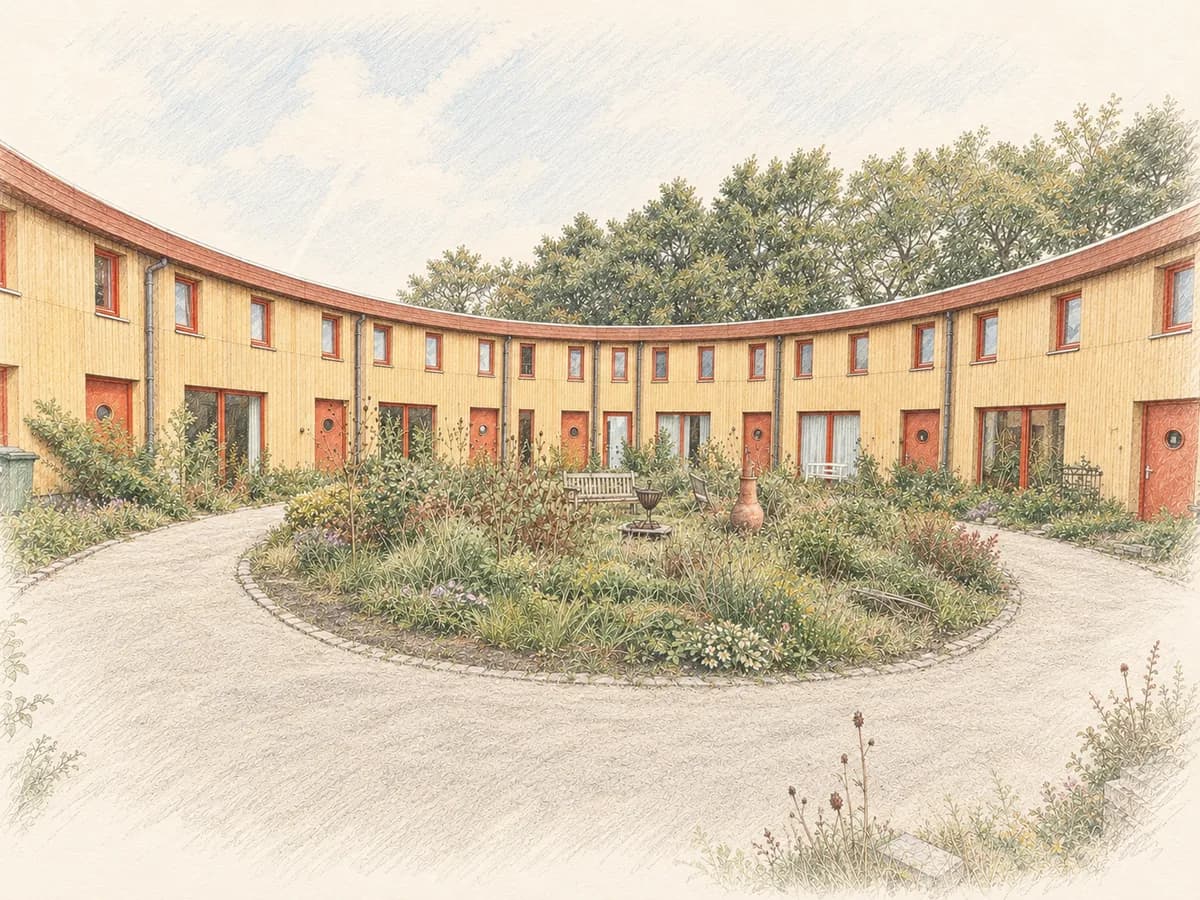
Boekel has 36 homes arranged in three circles. During our visit, Ad told us that 43 adults and 15 children lived there.
According to Ad, the homes were designed with the golden ratio in mind – a proportion of approximately $1:1.618$ used in architecture and art to create harmonious compositions.
Gradually, we became even more interested in what connects those homes.
"No matter how thick your wallet is, you can still live sustainably."
— Ad Vlems
Residents rent within a collective structure. The village's website explains the relationship between the residents' association, the property association and VrijCoop, which helps protect the homes from commercial sale and preserve affordable rental housing. Future surplus rental income is also intended to support the creation of new communities. (See: Ecodorp Boekel: organisational structure)
Listening, we imagined how far such a decision could reach. Homes providing security for one group of people today could eventually help others create a place of their own.
Ad explained that accessibility mattered from the beginning. The collective structure brings shared obligations too: when someone leaves, costs remain, so finding new residents matters to everyone.
Each household has its own home and private space. Nearby are people you can turn to.
Six homes are intended for residents needing additional support. During our walk, we heard how ordinary that support can be: shopping, cleaning, a cup of coffee and a conversation to help someone find their bearings and plan the day.
Details like these tell you a great deal about a place. They show how the large idea of "community" can take shape in an ordinary morning.
What the harvest table reveals
We visited on a Saturday, when residents work together. Some were gardening, others looking after shared spaces or handling organisational tasks.
Ad described the working groups and their use of holacracy – distributing responsibility through roles so that people can act within their area without bringing every small decision to the whole village.
Later, beside the harvest table, Ronald explained something that stayed with us: residents can take produce even if they do not work in the garden. They contribute elsewhere, perhaps by keeping the accounts.
We smiled. It is easy to recognise the gardener's work in a basket of vegetables. The person organising the finances is less visible, although the garden may depend on them too.
There is respect for different abilities in that arrangement. It allows someone to feel valued even when their contribution cannot be placed on the table beside the fresh vegetables.
Sharing the whole experience
Many conversations in Boekel moved naturally from human relationships to technology and back again.
The village presents itself as an SDG neighbourhood, connecting its development with the Sustainable Development Goals. Housing, water, energy, food and social relationships are considered parts of a shared undertaking. (See: Ecodorp Boekel)
Ad showed us an experimental thermal store intended to retain solar energy as heat for the colder months. He explained the concept of a large insulated store containing material from steel recycling, connected to the homes' heating system.
He was equally open about its status: at the time of our visit, it was not working as intended.
For people preparing to build, that kind of answer is immensely valuable.
"We share everything."
— Ad Vlems
We talked about how much time and effort can be saved by understanding the journey towards a result. Ad and Ronald described recording lessons from experiments, including unsuccessful ones, and sharing them with others.
Their willingness to do so carried the confidence of people whose purpose extends beyond needing to be right every time.
Beside the planted wastewater-treatment system, the conversation became practical again. Ad explained the biological processes; Ronald added the maintenance involved. Residents' everyday habits matter too, including the cleaning products they choose.
Here, you can see how technology becomes part of community life. Its effectiveness also depends on what people agree to and what they do each day.
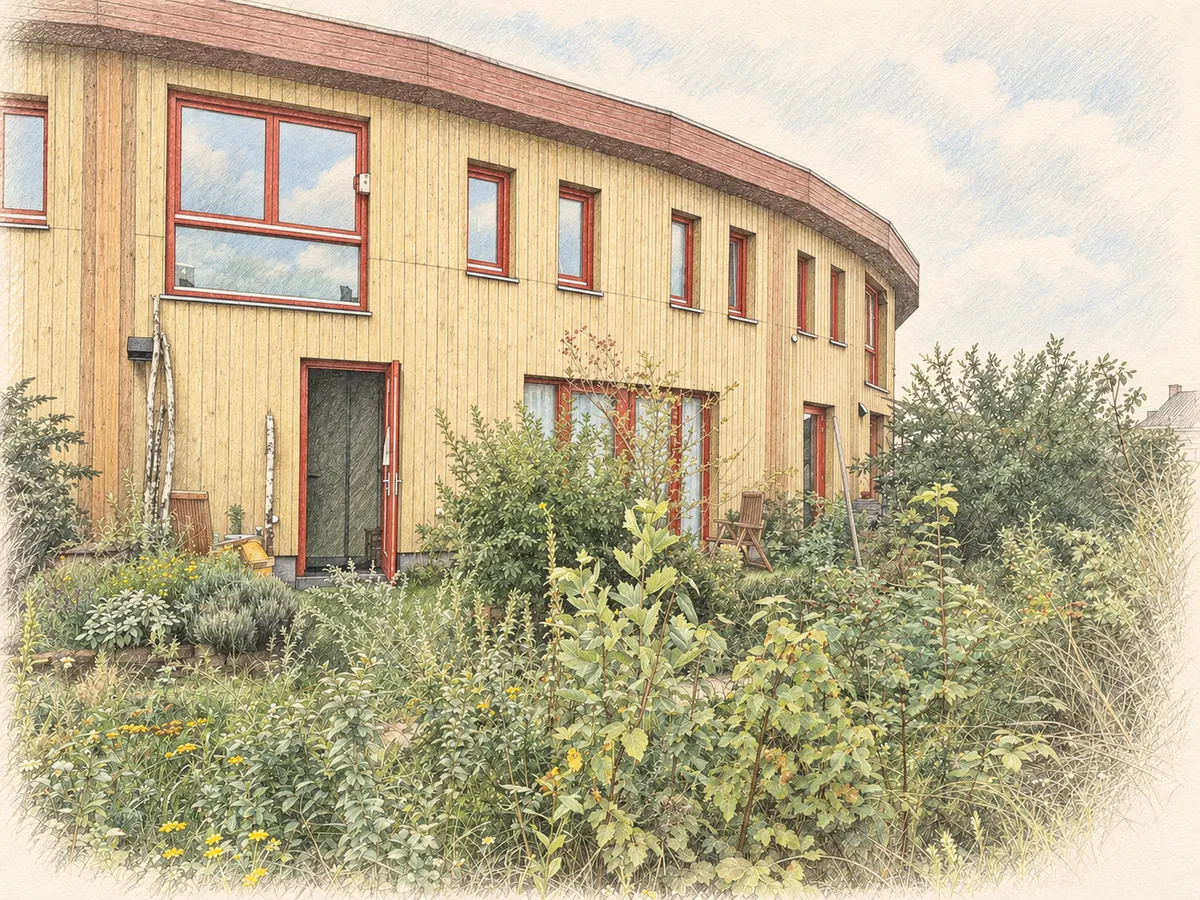
Some of the harvest belongs to the birds
Then we walked into the garden.
Ronald described how sandy the soil had once been. Now vegetables, fruit trees and herbs were growing there. There were composting systems, bokashi, and a messaging group letting residents know which harvests were ready to collect.
The beds had curved shapes. Ronald showed them affectionately, while joking about the practical complications of their geometry. He seemed to know each one well and to have a long, generally good relationship with it.
We liked that tone. Loving a place can mean seeing its characteristics very clearly.
He pointed out a hedge whose berries and seeds were left for birds. This small detail said a great deal about the understanding of abundance here. Some of what grows is intended, from the beginning, for other inhabitants of the land.
The shared space between the houses was changing too. We heard how an area that had previously collected water was gradually gaining paths, planting and places to gather. Around the fire, residents mark seasonal occasions, sing, celebrate and talk about experiences and loss.
Nearby, the community house was under construction. Its name is Wereldhuiskamer, the "World Living Room." The village describes it as a place for connection and sharing knowledge. (See: The community-house project)
After our conversation on the terrace, the name felt natural. We had already experienced how a meeting could unfold here: someone arrives, joins in, adds their experience, and the conversation becomes richer.
Boekel has also given rise to EkoBuild, an initiative started by residents Nynke and Sander, as described by GEN Netherlands. (See: GEN Netherlands: EkoBuild) Their own website sets out ambitions for healthy, affordable living, reuse of materials and collaborative approaches to building. This is the initiative's stated direction, and one we would be interested to explore further. (See: EkoBuild)
Again, the same thought: experience developed in one place can continue its life somewhere else.
What continues after a meeting
This understanding is part of why we are building ECOVE: to help people beginning their journey towards community, and those already living together, find one another, exchange experience and manage everyday responsibilities.
On ecove.app, this work takes shape through EVE, tools supporting community life and organisation, and Ecove Matcher, designed to help people find compatible communities and others with shared values. (See: About the platform)
For us, useful technology needs to account for people, their abilities, their time and their habits. When a difficult question has no ready answer, we want to convene a gathering of experience – people willing to seek a solution together.
Around the world, communities have different personalities and ways of living. In our travels, we repeatedly recognise a familiar wish to live peacefully on this planet, in good relationship with other people and with nature. Meeting one another helps us feel the strength in that.
During our conversation, Ad recalled a representative of GEN Europe calling Boekel the "gold standard" of ecovillages – for its commitment to being a useful example and sharing knowledge. We wholeheartedly agree. After everything we saw, those words ring true.
The people behind the place impressed us. In Ad, we felt foresight and quiet persistence. In Ronald, attentiveness to everyday life, openness and warm humour. With both, we experienced a friendly quality of leadership: a clear sense of direction and a willingness to talk, explain and hear another person.
Before leaving, we shared kombucha and a starter culture brought from Spain. A small gift after a generous conversation. It was lovely to leave something that could grow here too.
We will be very happy to continue this connection – to build friendships, stay in touch, exchange experience and find opportunities to work together.
Each meeting like this brings us back to our own project with a deeper understanding and helps us improve ECOVE.
This is how communities help one another grow – sometimes before the first house has been built.
Visiting or joining Ecodorp Boekel
- Visit the ecovillage. Information afternoons take place on the first Sunday of the month, with advance registration. Visitor information.
- Explore becoming a resident. Joining an ecovillage takes time to get to know one another. Boekel offers introductory Saturdays followed by a process lasting at least three months. Residents are expected to contribute at least eight hours each week. Confirm housing availability, costs and language expectations directly. Joining the community.
- Volunteer. Separate rules cover overnight accommodation and animals. Our personal welcome with dogs was an exception rather than a general permission. Volunteering.
Looking for a sustainable community, or people with whom to begin your own? Explore Ecove Matcher.
Credits & Notes
Text: Olesia Bohm and Richard Bohm. Based on their visit and conversation with Ad Vlems and Ronald, supplemented by the linked sources. The opening highlighted passage paraphrases Ad; the wallet quotation is lightly edited for grammar. AI-assisted pencil illustration based on a photograph published by Ecodorp Boekel; artistic interpretation, not a documentary image.
Reference photograph / Ecodorp Boekel
ecove.app / Ecodorp Boekel

Olesia Bohm
Contributor